

The world of Generative AI (GenAI) is transforming faster than ever—and at the center of this transformation is Python, the language that has quietly become the operating system of modern AI. Whether you’re building LLM-powered workflows, multimodal applications, or high-performance vector databases, Python offers a rich ecosystem of frameworks, libraries, and tools that make GenAI development faster, smarter, and more accessible.
In this article, we’ll break down the full Python power stack across model development, embeddings, vector search, RAG, multimodal pipelines, and more. If you’re a developer, AI strategist, or business leader looking to adopt GenAI, this guide will help you navigate exactly which tools matter—and why.
Why Python Dominates GenAI
GenAI requires flexibility, huge model ecosystems, rapid prototyping, and seamless integration between components.
Python delivers all four through:
- Massive open-source libraries
- Large community support
- Plug-and-play integrations
- Easy API development
- Rich support for AI experimentation and deployment
Its ecosystem is now the backbone of LLMs, multimodal systems, RAG pipelines, diffusion models, and enterprise AI applications.
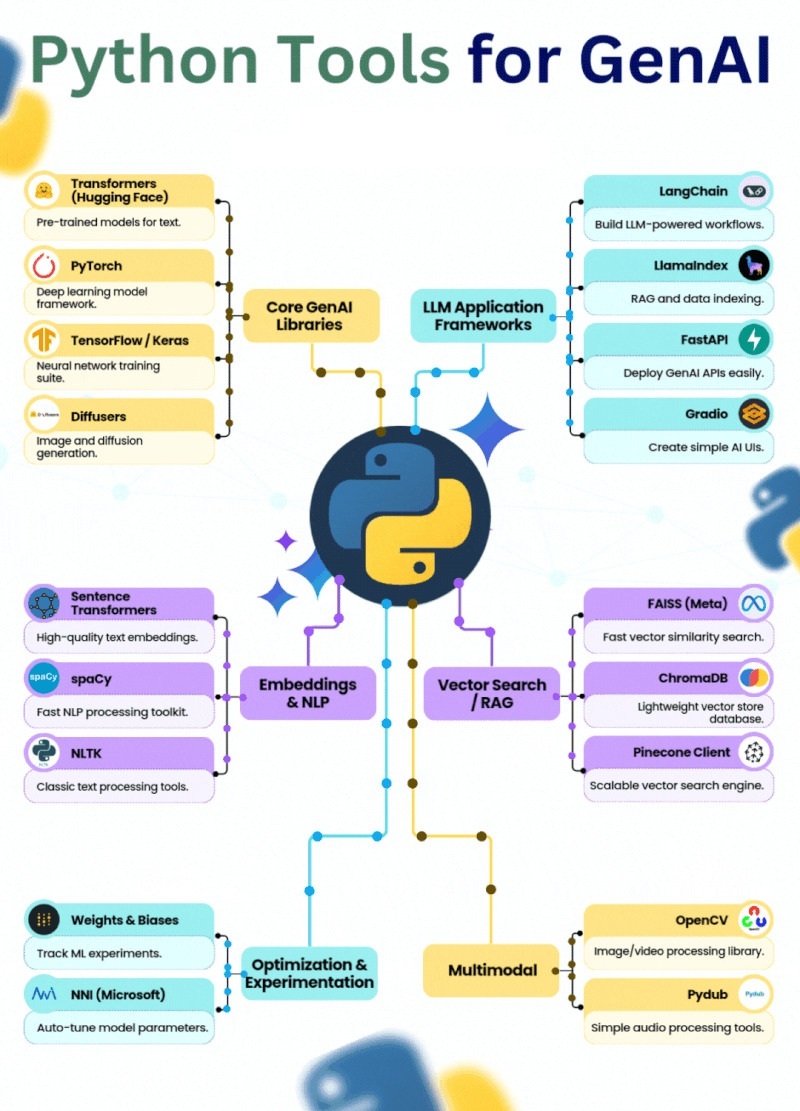
Image Credits: Prem Natarajan
These libraries form the foundation for developing and running GenAI models:
- Transformers (Hugging Face)
The world’s largest library for pre-trained NLP and multimodal models.
Supports BERT, GPT, T5, LLaMA, Stable Diffusion, and thousands more. - PyTorch
A flexible deep learning framework powering research, production, and many open-source LLMs. - TensorFlow / Keras
Google’s widely adopted ecosystem for deep learning, model training, and production pipelines. - Diffusers (Hugging Face)
A go-to library for image generation, diffusion models, and creative GenAI.
Together, these tools allow developers to build, fine-tune, and deploy powerful AI systems with minimal friction.
Building a GenAI model is just the start. Creating a functioning AI application requires orchestration frameworks—and Python has the strongest ones.
- LangChain
Build end-to-end LLM-powered workflows, agents, and pipelines. - LlamaIndex
Specialized framework for Retrieval-Augmented Generation (RAG) and data indexing. - FastAPI
Lightweight, blazing-fast framework for deploying GenAI APIs in production. - Flask
A minimal and flexible web framework ideal for quick GenAI prototypes, lightweight APIs, and integrating AI models into existing web applications with ease. - Gradio
A simple UI toolkit to create interactive demos and AI interfaces—perfect for showcasing LLMs or image models.
These frameworks turn your model into a usable application.
Modern GenAI relies heavily on embeddings—numerical representations of text.
- Sentence Transformers
High-quality text embeddings optimized for semantic similarity, ranking, and search. - spaCy
Fast, industry-standard NLP toolkit for text processing and understanding. - NLTK
The classic NLP library used for tokenization, parsing, and language processing fundamentals.
These tools help models understand language, structure content, and generate meaning at scale.
RAG (Retrieval-Augmented Generation) has become essential for building LLMs that respond accurately using real-world data.
Python supports the strongest vector search tools:
- FAISS (Meta)
High-speed vector similarity search for large-scale datasets. - ChromaDB
Lightweight, developer-friendly vector store ideal for rapid prototypes. - Pinecone Client
A scalable vector database for enterprise-grade RAG applications.
These tools enable memory, personalization, document retrieval, and domain-specific intelligence.
Modern GenAI is multimodal—working with images, audio, video, and beyond.
- OpenCV
The go-to Python library for computer vision, image processing, and video analysis. - Pydub
Lightweight audio processing library for speech, sound engineering, and multimodal models.
These tools unlock the next wave of GenAI products: intelligent cameras, audio assistants, smart editing tools, and more.
AI development is iterative, and Python has powerful tools for experimentation:
- Weights & Biases
A full suite for experiment tracking, model versioning, and performance visualization. - NNI (Microsoft)
Auto-tune hyperparameters and optimize model configurations automatically.
These tools bring scientific rigor and repeatability to GenAI development.
Final Thoughts: Python Is the Fuel Behind the GenAI Explosion
The Python Power Stack is more than a collection of tools—it’s an ecosystem that empowers developers to move from idea to innovation in record time. Whether you’re building:
- LLM apps
- RAG pipelines
- Multimodal AI
- Image or audio models
- Intelligent search engines
- Enterprise-scale GenAI systems
Python offers the perfect blend of flexibility, community, and high-performance tools.
If you’re venturing into the GenAI revolution, you’re building on the right foundation.
